National Allotment Week 2018

National Allotment Week is running until Sunday 19 August. Here's a chance to win an Earth Cycle bag of compost.

Start the outdoor experience from your kitchen


The sun is shining. Got some spare time for the allotment or back garden? Eager to get out amongst some greenery and feel good? Why not start that feeling while you’re having breakfast, right in the kitchen?

You can create a vertical garden in the kitchen with plants on floating shelves. Instal a small tree to make an accent. Live plants in the kitchen are great, but have some associated pitfalls. Trees and plants need regular care and maintenance to keep them healthy. They require regular trimming and pruning to keep them in shape and limited within the space. They are also prone to mould growth, which requires periodic application of pesticide. Not good in a kitchen.

But artificial trees and plants, such as those at Museum Trees, have no such hassles. They are professionally made using high-quality foliage and strong, colourfast pigment to make them absolutely lifelike. Thus, the faux greens deliver the same aesthetic beauty as their live cousins. Available in a wide variety of size and types they can fit all interior decor requirements and allow customisation to fit into any space constraints. The great thing about faux greens is they do not require any sunlight and can be placed anywhere. You can enjoy an improved ambiance throughout the year.

Cemetery Road Allotments, Birkby, Huddersfield

It's quite shocking to find allotment holders still having to battle to save their precious patches. But it's happening again in Huddersfield. A new school is planned for September 2018. To satisfy Sport England's requirements for a public football pitch, Kirklees Council are moving allotment holders to other sites. All because Greenhead College won't allow public use of their football pitches.


The Council are offering to pay for moving greenhouses and sheds. But the loss is more fundamental. It's the break-up of a community and loss of decades of blood, sweat and tears making each allotment something unique. All for a football pitch, when there are several already available nearby. Many of the more mature allotment holders won't have the will to start again.

If you care about allotments and want to do your bit for our friends at Cemetery Road Allotments, please sign their petition. And of you want to keep up to date with progress, like the Cemetery Road Allotments Facebook page.

Please vote!

Waltons are running their annual competition for the best allotment blog of 2017. They've chosen some entertaining and interesting blog sites in their list of fourteen. Honoured to have Allotment Heaven included.

Got ten minutes or so to spare? Why not have a read of the sites and place your votes? You're allowed to vote for up to three. And if you choose to include Allotment Heaven as one of your votes, thank you!

Do you dig it?

Allotment looking a bit sorry for itself? Covered in weeds and looking beyond hope? This past year has been a bit of a disaster for me too. Family commitments left little time to do anything on the plot. Result? Weeds, weeds and more weeds.

Autumn is the perfect time to get back on top. The objective is to turn the soil so winter frost can get right into the ground. If your soil is easy to work, aim to remove all weeds. First job on each subsequent visit is to rake over the areas already worked to upset any new weeds.

Unlucky and have heavy clay soil? Don't worry too much about removing all the weeds. Your aim is to turn the land spadeful by spadeful, dumping the weeds upside down. The bigger the clods of earth the better. Frost will reach right into the earth to break up those lumps of clay. In early spring you can re-dig the land, now more easy to work, removing any remaining weeds.

You might think you can spend a whole afternoon digging for Britain, but pretty soon you'll be finding excuses to avoid another muscle-aching session. Much better to restrict yourself to a couple of hours or less. That's enough time to make progress without killing yourself. You'll be amazed how quickly you get the plot back under control.

Don't delay. Go get that spade and boots. Don't forget the coffee and cake for half time. Here's the result after my first tidy up session...

19 amazing allotment blogs


Thank you Waltons, for including Allotment Heaven as one of their 19 amazing allotment blogs. To read the full list of entries, click here.

Bee friendly


It's hard to understate the importance of bees. Don't just think honey. We rely on bees and other insects to pollinate most of our fruit and vegetables. Sadly, our bee population is under threat from intensive farming, urbanisation, disease and other factors. In the last century 20 species have become extinct in the UK, with another 35 currently under threat. 

The honey bee and bumblebee are the most recognisable of the species. Actually there are about 270 varieties. And not all depend on a hive. Some bees are solitary. 

The strange thing is, places that are good for bees are good for people too. We share their love of varied, natural green spaces, clean air and water. We both love wild areas full of blossom. Grow plants that attract bees and not only will your allotment or garden have the happy background sound of buzzing, you'll improve your chances of a better fruit, vegetable and flower crop too.

Suttons Seeds have produced a useful infographic giving more information and action you can take to encourage bees in your allotment or garden. To view this click here. There's also a useful list shown below of bee friendly plants to grow throughout the year, produce by Friends of the Earth.


Grow your own superfoods

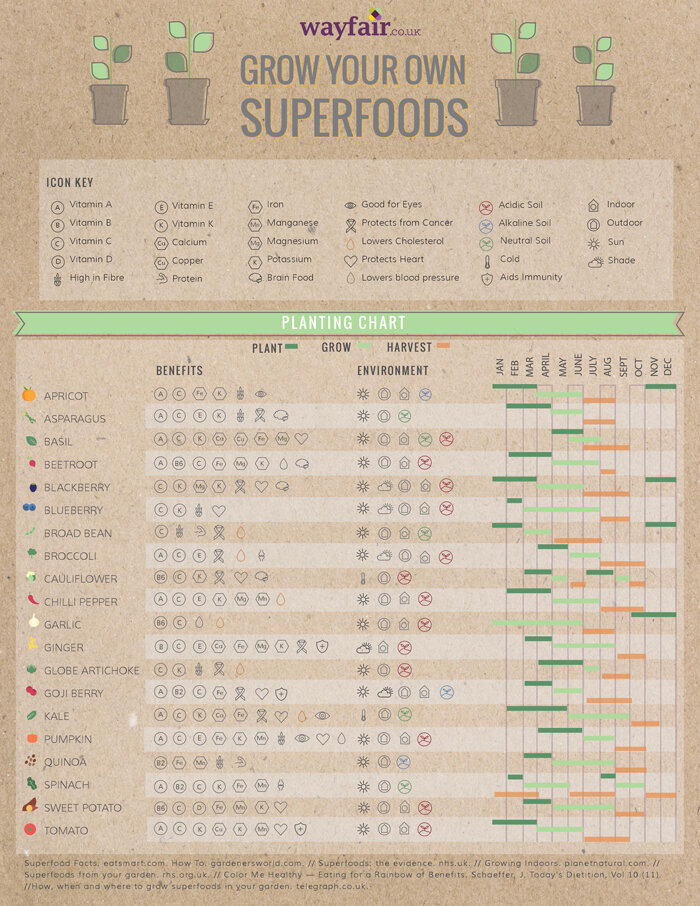
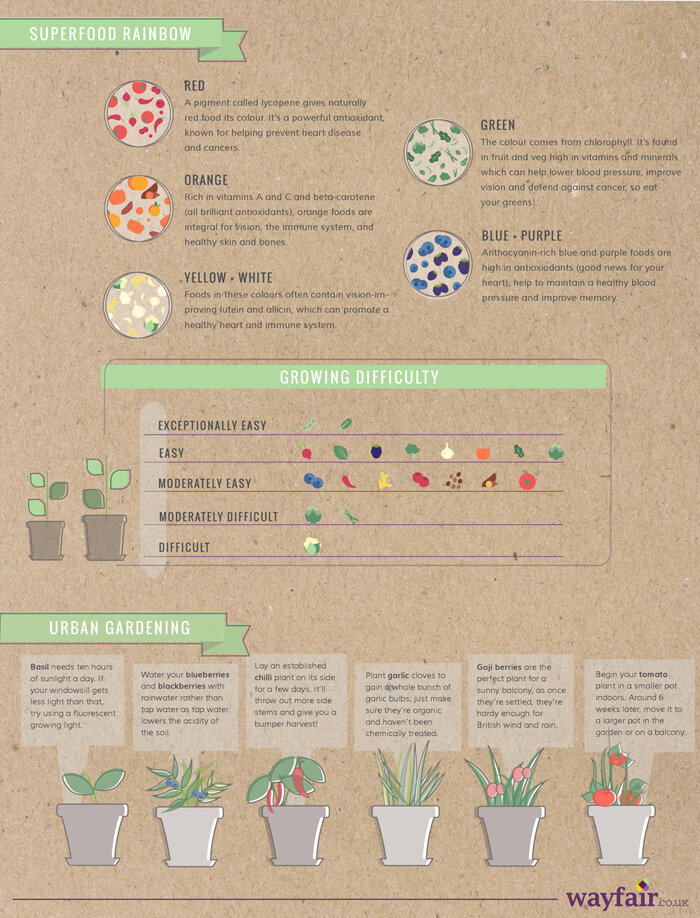
Superfoods is the latest food industry health buzzword to persuade us to buy their products. There is lots of evidence they really do you good. To read independent advice on their benefits from the NHS click here.

Having convinced yourself they're a good thing to have in your diet, here's a helpful and informative guide to growing your own superfoods. Just click either image to access more information about superfoods. If you'd like to print this guide, click the Print Friendly button at the foot of the post.

Grow Your Own Superfoods Grow Your Own Superfoods

Social history website


So damp over the last few weeks, there's been little chance to do anything on the allotment. So what's been occupying me?

I've been building a social history website all about St Ives. It's such a beautiful little town with an ancient history. Quite a bit of my time has been spent transcribing newspaper reports from 100 years ago mentioning St Ives in local and national newspapers. 

Seems so much further back in time. Transportation to Australia for minor offences, and public whipping. World War 1 seems to have crept up unannounced locally, but pretty soon all the town was taken up with military manoeuvrings. Poignant letters from sons at the Front. And the first news of casualties and deaths in battle.

If you're interested in that type of thing, click the image above to go to the website.

Vegetables to plant in October

October is a forward-looking month. Time to plan for spring. So here's a list of vegetables to plant now.

Garlic
Garlic cloves are best planted in Autumn. They benefit from a good dose of frost. Don't need much tending once in, just keep the weeds at bay, water when dry from late spring and cut off any stalks that appear. Read more >

Broad beans
Autumn sown broad beans mature a good month ahead of spring-sown varieties and are more resistant to mildew. Sow two inches deep, eight inches apart. Support with canes as they grow. Water as flowers appear and once a fortnight thereafter.

Onions
Sow Senshyu semi globe yellow seeds now for perfectly sized onions next July. One packet will supply enough onions for you and all the family. Read more >

Spinach
Still a couple of weeks left to sow spinach for a nutritious, tasty and trouble-free crop over winter. Read more >

St Ives Flower & Produce Show 2015

The summary, exhibitor results and photos of this year's show are now available, learn more >

Zen and the art of weeding

Few things are more satisfying than doing a bit of weeding. Why? Because it achieves on all the important levels. So it...
  • Makes you slow down
  • Compels you to take notice
  • Returns a sense of achievement

Really? Just try it. Of course, it's more satisfying if you've got good alluvial soil and the weeds are all annuals. So much easier to pull. But even if your soil is clay and it's full of couch grass, it's still worth the effort. Will just take longer. And who else is going to do it?

So take a couple of hours out. Pack a snack and flask for a half time break. Put the radio on low volume. Get comfortable. Slowly and carefully work away. You'll be surprised what progress you make and how restful the work is. And to quote from the original 'Zen and the Art of Motorcycle Maintenance' by Robert M Pirsig...
We want to make good time, but for us now this is measured with the emphasis on 'good' rather than on 'time'...

St Ives Flower & Produce Show 2015


Getting to the exciting stage!

Posters all around town. Programmes available to pick up at West End Stores, St Ives Town Council offices, the Corn Exchange, St Ives Library and the Farm Club. Big banner goes on The Waits railings in a week.

Just waiting for the first of 400+ exhibit entries to come in by the deadline date of Monday 31 August. No doubt it will be the usual last minute rush. Always amazes me that almost all the entries come in over the last two days. With cars frequently drawing up outside the house for just a few minutes, the neighbours must wonder what's going on.

Will we get 400 entries as last year? Or 700 for the previous year and all the problems of squeezing the exhibits in the hall. How about more than 700? And that's the exciting bit. Won't know until a mere four days before show day!

Lots more information at the show website, including a link to download the online programme.

Review : Grow2eat.com

This free annual magazine, available by registering online at Grow2eat.com, supports a web site whose aim is to grow a community of enthusiastic gardeners and allotment holders. There's also a Facebook site.

In exchange, members have access to discounts on a range of products. The magazine includes a handy chart about when and where to sow seeds. Also shows when to harvest.

Registration is straightforward. You're given a promise of no spamming and can opt to receive a bi-monthly newsletter highlighting the latest discounts. New providers and savings are added weekly.

Once in, you have access to a range of products typically offering a discount of 5% or 10%. The range is broad. Everything from an eco loo to seaweed fertiliser, garden benches to volcanic rock dust. Also discounts on a variety of seeds and plants.

Might be nice to see a mention in either the magazine or on the web site about how Grow2eat.com ensures the quality of products offered. There is a feedback email address.

Worthwhile registering? The suppliers aren't mainstream, but it's likely there'll be something of interest. With a serious browse of the Internet you may find cheaper prices. On the other hand, you might find what you're looking for on Grow2eat.com's web site and save yourself the hassle. It's free, so worth a try.

In praise of stillness

Had a go sitting in the middle of your allotment (garden, park, countryside...) to just listen and see? Try it. Not only therapeutic, it will surprise you.

Healing
Life is just too too busy. Rushing to work. Rushing at work. Rushing home. No longer work? Those constant demands on time still mean there's little time to relax.

And by relax, I mean relax. No mobile 'phone. No thinking about what you've got to do later or what happened yesterday. Find a comfortable spot. Just fill your mind with what you see and hear. Concentrate on the area immediately around you.

It's hard to do, especially if there's the sound of traffic in the background. But with concentration, what is happening just a few feet away will take precedence.

Surprise
You'll notice things that have always escaped your attention. The symphony of birdsong. Colourful spiders hanging below a leaves. Ants on safari. A solitary bee, it's home a hole in the soil. A paintbox of flowers. Acrobatic dragonflies.

I've been nose to nose with a field vole, feeding on discarded beetroot. They're nearly blind, so a bit of careful creeping gets you really close. Watched a wolf spider patrolling beside my pond. If you have chickens, they're a source of constant amusement.

When to observe
Early morning or at dusk during spring, summer or autumn are the best times. Lots of wildlife needing to feed. But any time of day is beneficial.

Try it in winter? Are you crazy? Most wildlife is tucked up warm and cosy... just as you should be!

Chives

Is there anything as easy to grow as chives? Doubt it. Grow from seed, even better if you can get a few bulbs from a friend. Within a season you'll be splitting the bulbs, making yourself a bigger display.

In fact, you'll need to divide the plants every three or four years to keep them productive. And it's a good idea to cut plants back monthly during the growing seasons to maintain a steady supply of fresh stalks. If you cut back alternate plants every fortnight that will ensure you have a constant supply. That's about the only maintenance required.

Look great planted in a pot even before the bright purple flowers burst forth in May. Drying the flowers prolongs their use. I use them for decorative edging, as shown above on my allotment. They're great for attracting bees.

Milder in taste than onions or garlic, not only are a few chopped stalks great with cheese, potatoes or to liven up a salad, they season dishes with their more subtle onion flavour. The flowers are edible too. Rich in vitamins A and C, calcium and iron, their medicinal properties are like garlic, but weaker. So eating chives is good for you. They're good for other crops too. Planting chives between carrots repels unwanted bugs.

The best annual flower to grow from seed?

No question for me... cosmos. Here's my first batch for 2015. Four days from sowing to showing. Must be the fastest germinating seeds around.

Varieties from two to four feet. Big choice of colours. Heaps of blooms. Trouble free. Cover a big area for no more than £1, and best of all they'll flower right through to the first frost of winter.

Unconvinced? Just try them. You won't be disappointed. Just look below at the display I had last summer...


Cape Gooseberry

Hurrah! Almost given up on the cape gooseberry seeds planted a couple of weeks ago. A stray weed seedling that popped up within a couple of days fooled me into believing that was it, and the rest of the seeds had failed. But no, here they all come pushing their heads up through the compost.

The seeds were a gift from a fellow allotmenteer last year. How could he refuse me after I'd drooled over his strange and exotic plant with papery pods and bright orange fruit? Now I'll have about fifty. But that's good... I can give some away to friends and family and gain swap credits in the process.

They're such an attractive looking plant. Even better, the fruit are delicious to eat. Here's an image of what I'm looking forward to.


It's crunch time...

First of the salad vegetables planted out. Arctic lettuce, grown from seed on the magic study windowsill. As usual, sown far too many. Good to get something fresh and green on the plot.

Even better to come, though. Managed to get lettuce seeds for the rare Brown Goldring lettuce from friends. The plants grow strongly throughout the year with sweet and very crisp leaves. Make space for more seed trays on the windowsill!

You might also like...

Related Posts Plugin for WordPress, Blogger...